
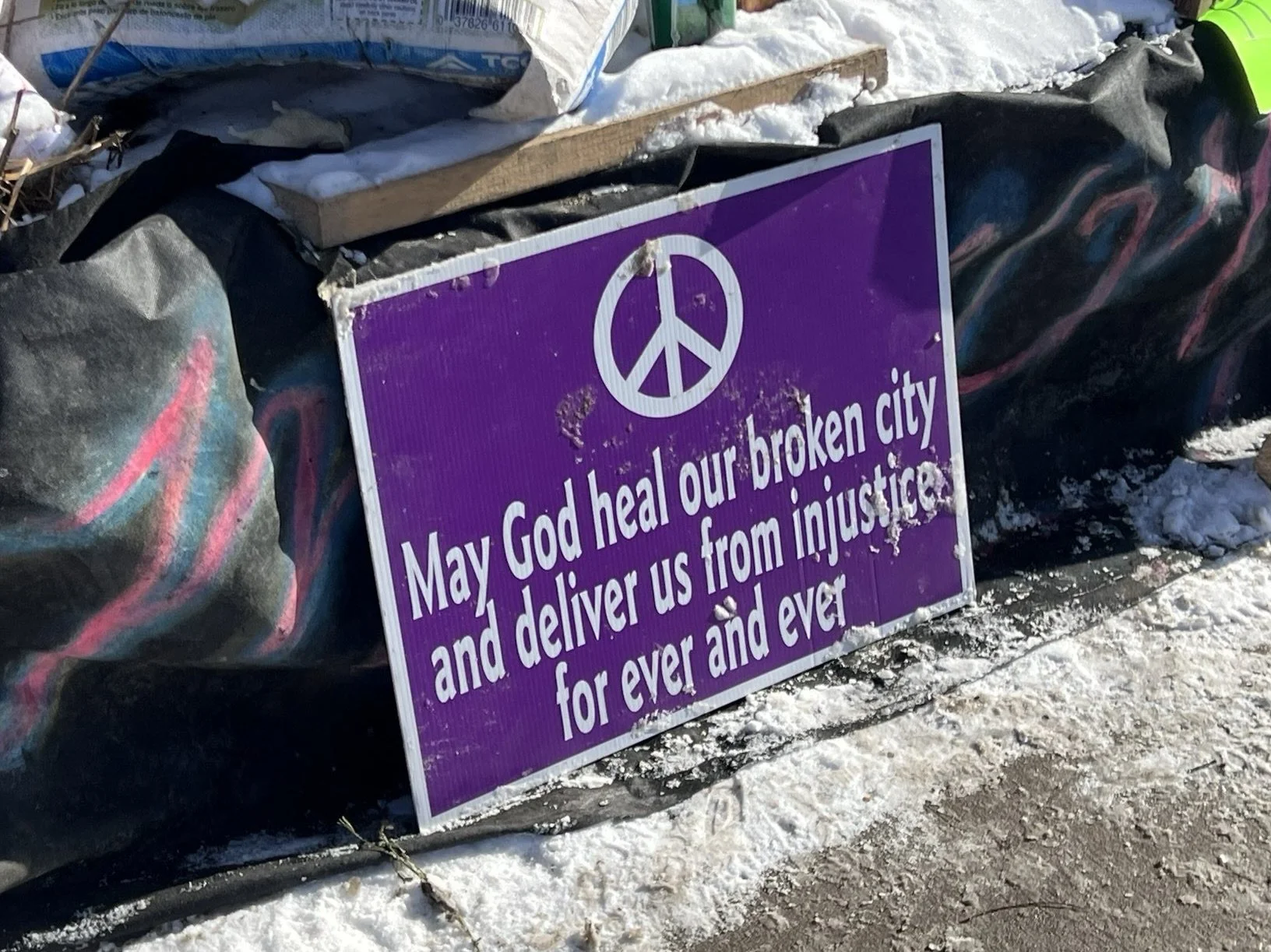
A sign displayed at the Renee Good memorial site in Minneapolis
On Saturday morning, I got on a plane home to California after spending two full days on the ground in Minneapolis. I was one of more than 600 clergy who had answered the call from MARCH, a multi-faith organization in Minneapolis, inviting faith leaders from around the country to come, bear sacred witness to what was happening on the ground there, and support the community by participating in the general strike and day of action that had been called for Friday, January 23rd. It was a sobering and inspiring visit. As I got on the plane Saturday morning, I was leaving feeling chilled more by the pernicious presence of a full-on federal occupation than the 20 below temperatures outside. But I was leaving also extremely heartened by the genuine warmth, ingenuity, cooperative kindness and resilience of everyday Minneapolis residents. I saw how these loving community members are reprioritizing their entire lives to give whatever they can in the protection of their neighbors and their communities. And then, mid-flight, I watched one of those brave, caring community members, Alex Pretti, executed on the same street I had walked the day before.
It’s taken me a few days to settle and begin to collect my thoughts about what I witnessed and learned during my short stint on the ground in an American city under siege. There will likely be more insights to share with the benefit of time and more processing, but just days after returning home, here are some of the takeaways I’m sitting with currently:
The scale of occupation is hard for outsiders to imagine.
I answered the call to Minneapolis because I knew the community was in crisis, but from a distance, it was hard to wrap my head around how that crisis was embodied. Being on the ground there (even for just two days) was a different experience. It’s clear that unlike some larger scale ICE deployments in cities like Los Angeles, this was not a targeted set of activities concentrated in a few neighborhoods, while other parts of the city felt relatively “normal”. This entire community has been transformed, and everyone who lives there is directly impacted by it in some way, whatever their race, politics, or citizenship status.
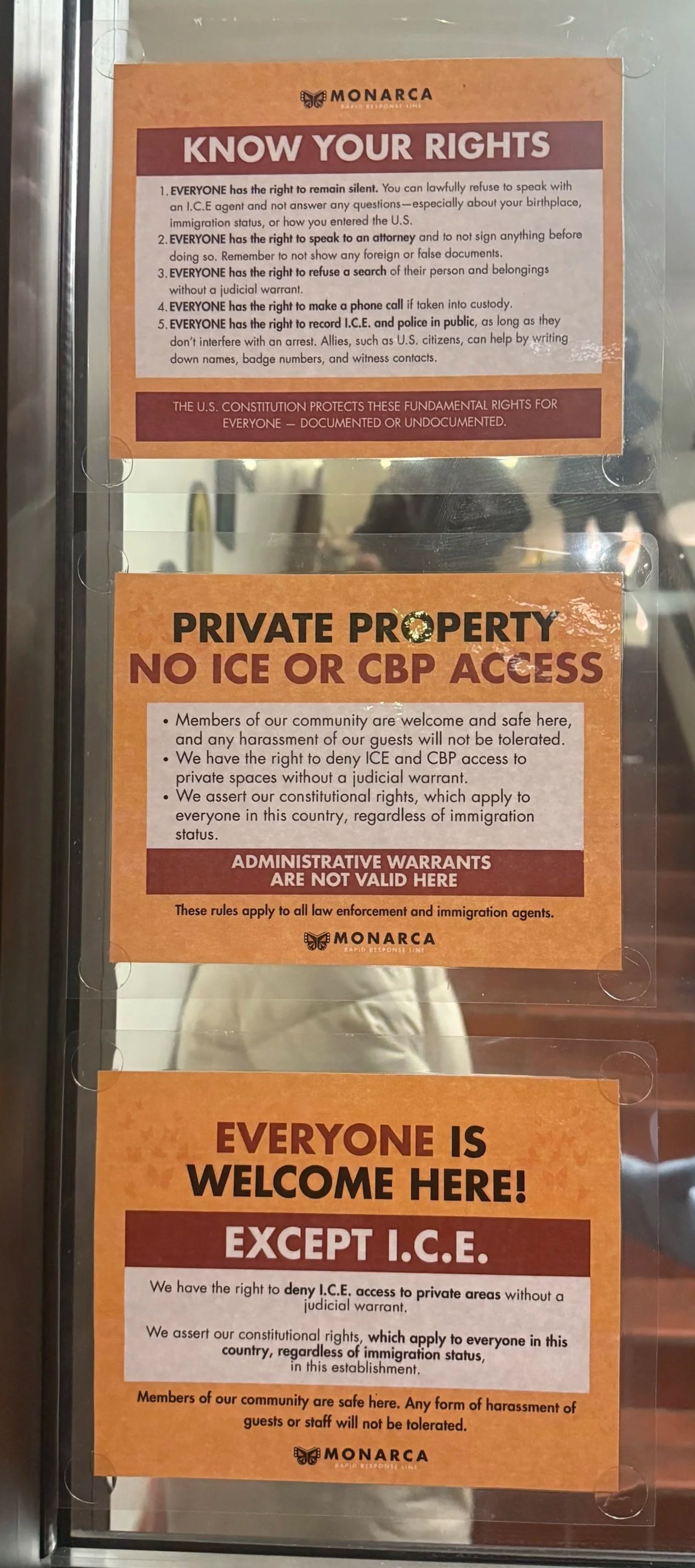
Many businesses and community centers display signs like this in their windows
Whole swaths of the community are no longer coming outdoors, and it’s not because they’re scared of the cold. People of color know they are vulnerable to harassment and capture if they step outside, even just to get their groceries, take their kids to school, or visit the doctor. Businesses that serve communities of color have seen their sales drop dramatically. Some of them are seeing a majority of their staff no longer coming to work. Schools have returned to covid-era online learning, impacting every school age student, as classes are reconfigured and teachers reassigned, with some teachers teaching online classes while others try to care for the kids still coming in-person, wondering what has happened to their young friends. More and more babies are being born at home because ICE has been patrolling OB-GYN clinics.
Of course it’s not just the folks who are missing that change the tenor of a community. ICE vehicles are driving recklessly through the streets - regularly speeding through residential communities, rampantly running red-lights, crashing their vehicles into telephone polls. They’re busting the windows of folks observing them. They’re deploying tear gas into nonviolent community responders regularly (our small group encountered it twice on Friday as we drove through South Minneapolis). They’re harassing people on the streets.
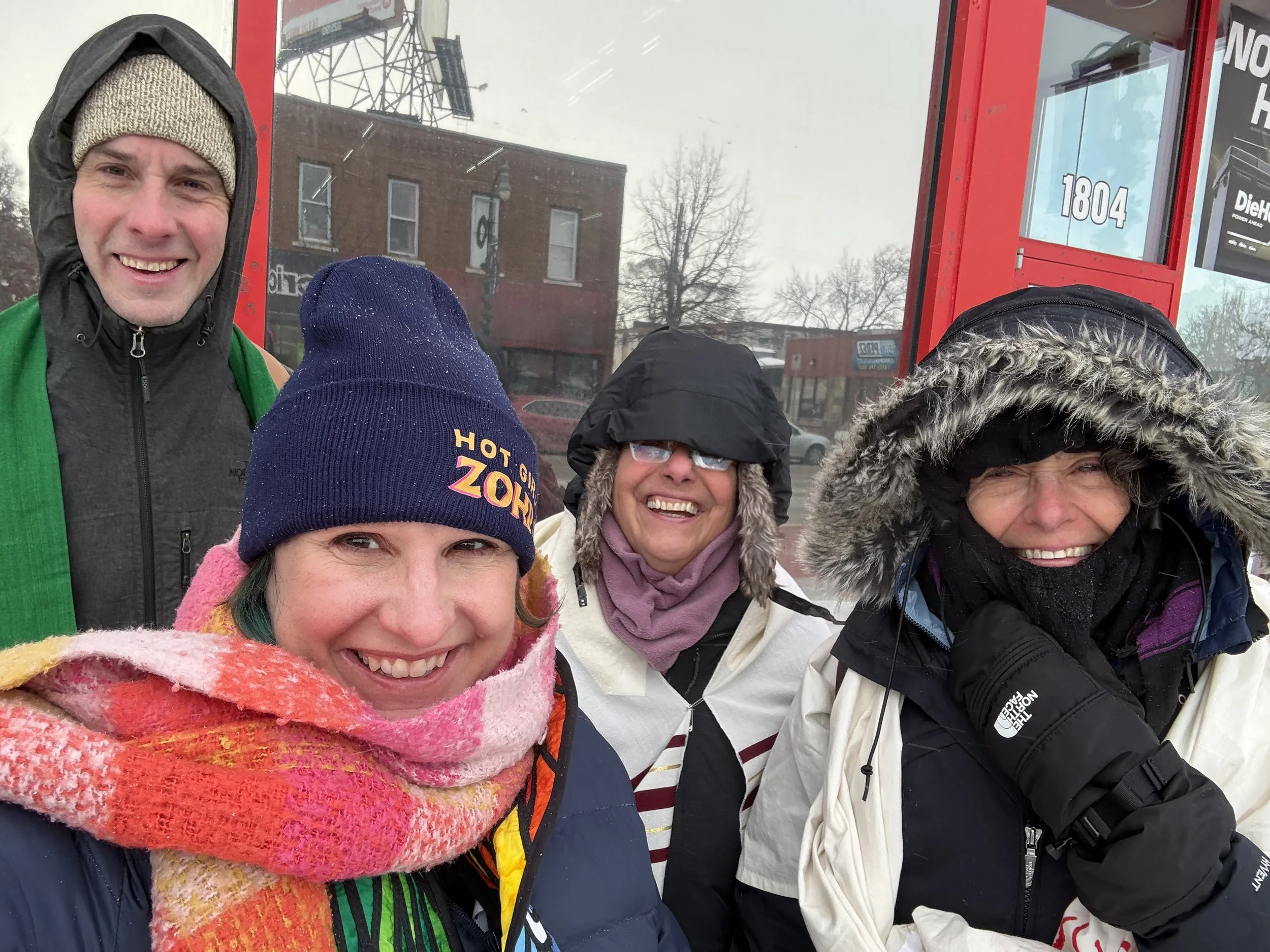
Two pastors, a Rabbi, and a rabbinical student on foot patrol
On the first day we were there, our clergy cohort was sent out in small groups with whistles to join “foot patrols”, walking around a heavily impacted corridor to keep an eye out for ICE harassment. In the one hour we were there, one group witnessed twelve agents surround a visibly pregnant woman. The clergy began whistling and filming the encounter they were witnessing, and eventually the agents backed off.
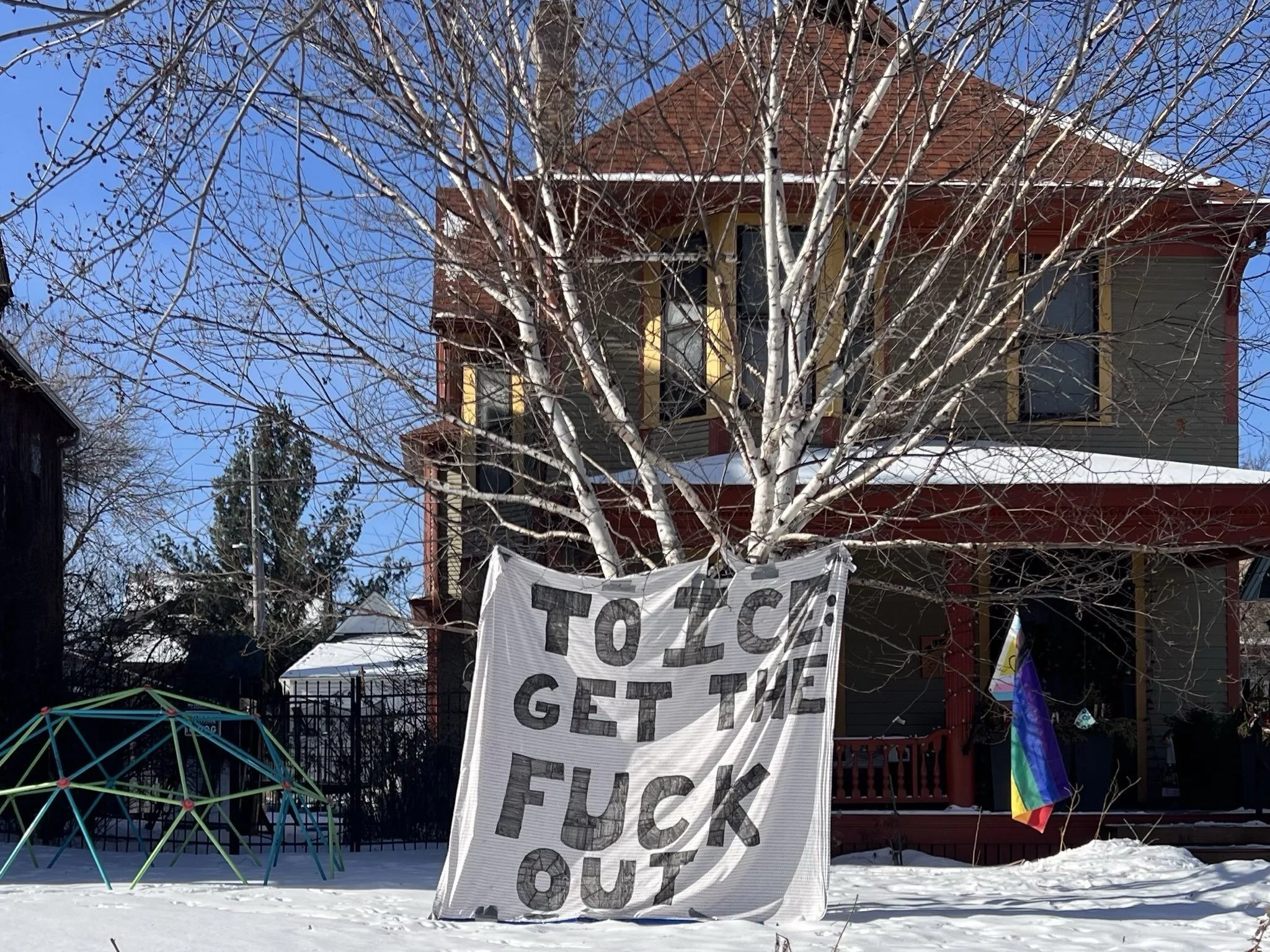
Throughout the city, homes are decorated with messages to federal agents. This one is just a few blocks from the site where Renee Good was killed.
The presence is ubiquitous and felt by everyone you encounter - from shop owners, to middle class white neighbors, to Uber drivers. Some houses still have their Christmas lights up, but many others have adorned their homes with messages about what is happening in their city. Most business have signs in the window that declare that “Everyone is Welcome Here: Except ICE”.
Perhaps the part I found most chilling about the occupation was the extent of digital surveillance being deployed there. On Friday, a small group of us spent the morning joining the protest at the Whipple Building, the Federal building that is ICE’s hub of operations. I was there leading song, to bring moral grounding, love, and resisting joy into the space. Within a couple of minutes of beginning to sing, I noticed a very large camera pointed directly at my face. It looked like a press camera, except within moments of having my picture taken I realized the photographer had no “press” identification visible. “ICE just took your picture,” my Minneapolis companion told me. “You’re in their database now.”
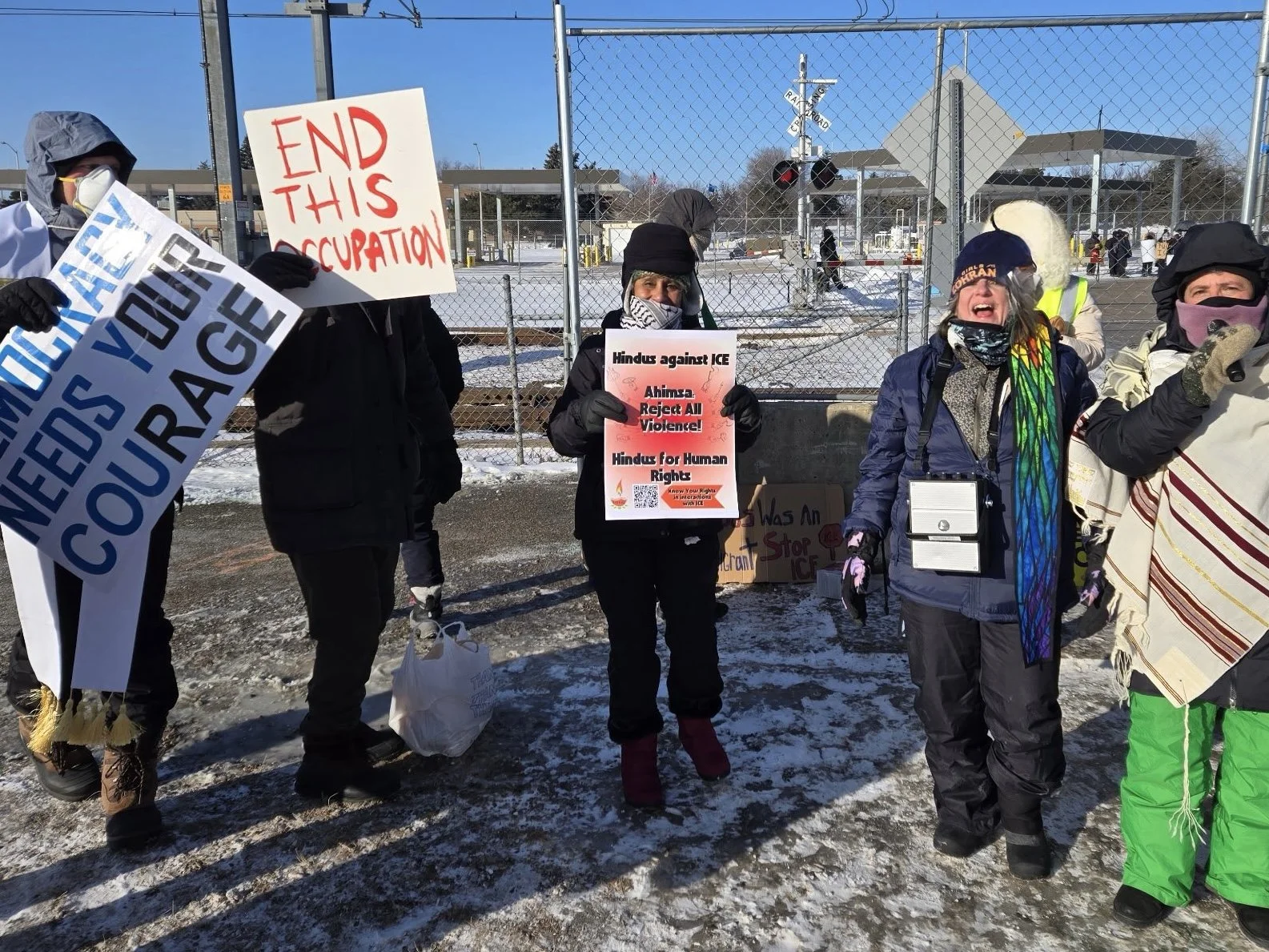
Singing at an action at the Whipple Building
Federal agents clearly enjoy the technological tools they’ve been given permission to employ. In recent weeks there have been multiple reports of community members following ICE vehicles to monitor their activity, and finding the agents driving them by their own homes and pointing at them. This is the occupiers’ pernicious way of saying to their witnesses, “We see you behind us, we know who you are, and we know where you live.”
Probably the most creepy story I heard was from one of our new Minneapolis friends. (I’m changing some identifying details to protect their identity.) They had driven a handful of hours away to a city in a nearby state for an event. While there, they stopped at a fast food restaurant for a meal. On exiting the restaurant, they received a Facebook Direct Message from someone they did not know saying “Stop messing with ICE, and enjoy your sandwich.”
The scale of organized resistance is even bigger.
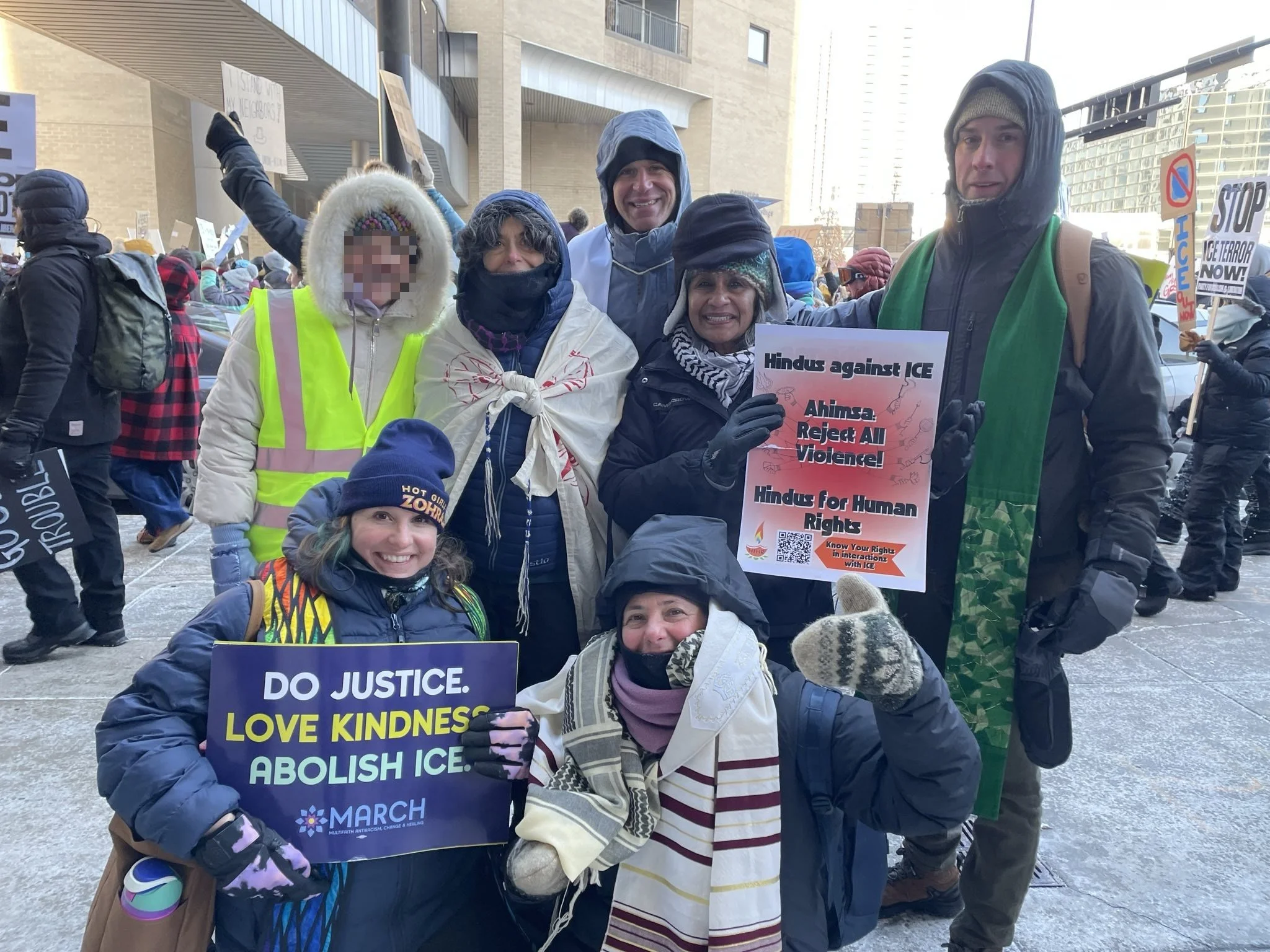
Our cohort on Friday at the 50,000 person march in VERY cold weather
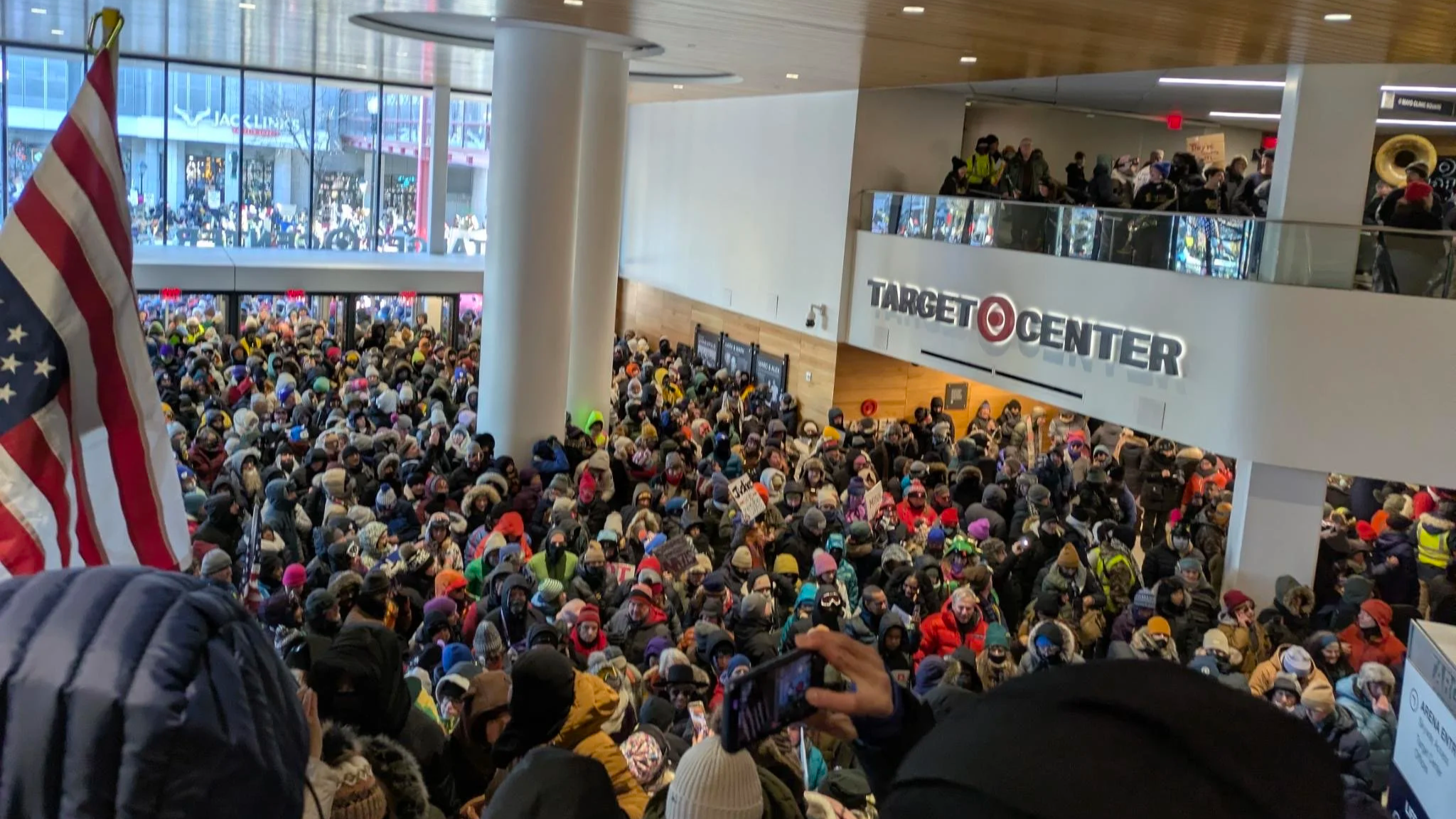
The crowd entering the Target center for the rally after the march
As scary as everything I named above sounds, here is the good news: the people of Minneapolis are beyond incredible. Many of you probably saw the images of the mass demonstration that took place on Friday, as the city came to a halt with a general strike, and over 50,000 people marched in negative 20 degree windchills. That was an amazing experience to be a part of, but that event was only the visible surface of a much broader and deeper sustained level of organizing that is happening every day in Minneapolis, invisible to many. In real time the people of Minnesota are building a powerful, resilient, innovative, collaborative web of protection for their community that goes beyond any mutual aid effort I’ve had the opportunity to witness. It seems to be not mutual aid as an action, but as an ongoing sustained, creative practice. As new needs arise, new community responses arise to meet them. As ICE tactics evolve, so do the tactics of providing care.
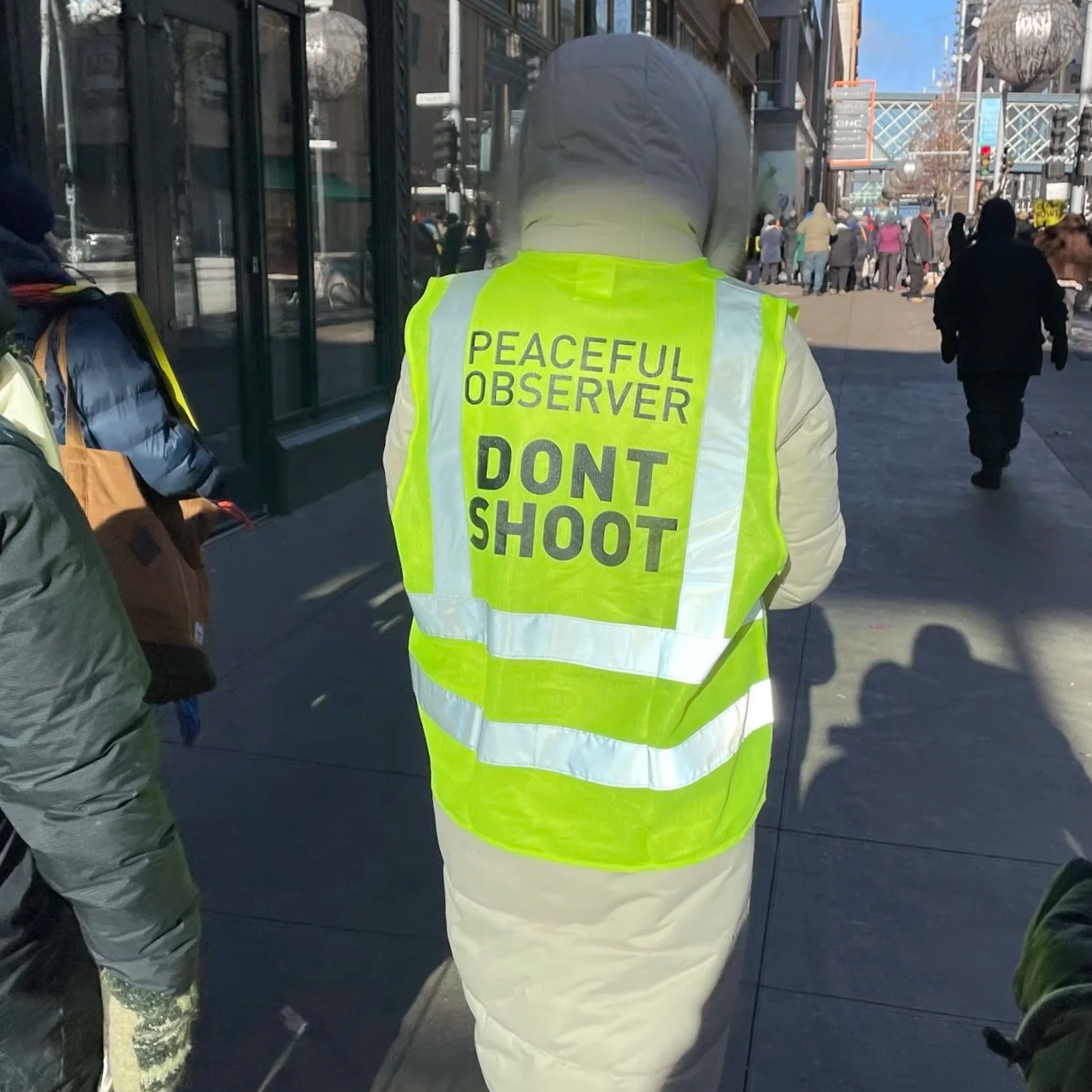
These vests are being distributed by a local sex shop to community members protecting their neighbors
We got our first taste of this the moment we left the airport. Our driver was one of the thousands of everyday neighbors participating in the Rapid Response network - a call-in network, hosted over Signal, of folks driving the streets and reporting ICE activity or suspicious vehicles throughout the community, and responding to needs in real time. From the first time we heard these voices, I was so impressed by their level of organization, their professionalism, their friendliness with one another, and their calm, even while at times reporting incidents that were extremely distressing. This was no coincidence, and it went beyond them just being “Minnesota nice”. These folks were trained and practiced. No, these are not professional activists. No one is paying them to do this. They are soccer moms and retired grandmas and students and ICU nurses, like Alex Pretti. They are giving whatever spare time they have to get good training in nonviolent resistance tactics, and then to use those tactics to protect their neighbors. Even as the work is becoming more and more dangerous, more and more folks are stepping into it, with a core conviction that it is the only way forward to protect the community they love.
And that’s not just happening through these neighborhood patrols. People across the spectrum of identities and even political opinions are finding ways to respond to felt needs with abundance. Our California to Minnesota contingent experienced that with the overwhelming hospitality that was lavished upon us throughout our visit. Upon hearing we were coming, one host put out the word on Nextdoor, asking if anyone had a spare bedroom, spare winter wear, or food to provide to clergy coming from California. The response was overwhelming. We had housing within minutes. Our first evening, we went through several large bags of gloves, hats, snow pants, boots and coats that folks had lent for us to use. More food was brought for us than we could eat. On the night of Alex’s death, one of our hosts took an extra donated casserole to the memorial site and gave the warm food to a group of grateful demonstrators there.
In addition to the community observers, there are large scale, massive efforts, all organized and sourced by volunteers, to deliver groceries, medications, and any other needed supplies to those who are fearful to leave their homes. (We heard one volunteer describe taking formula to a family where a six-month old nursing baby was without their mother because she had been kidnapped.) Others are arranging play dates for the school children trapped in their homes, or driving kids to and from activities so their parents can stay protected. These responses, even among people who don’t know one another’s names, are loving, generous, and abundant in every way, and provide a felt contrast to the harsh cruelty embodied by the agents of terror that represent our government, funded by our tax dollars.
And this brings me to the final takeaway I’m sitting with:
We all need to learn from Minneapolis.
Everyone we encountered in Minneapolis was grateful for the presence of the hundreds of faith leaders who had come from across the country to witness and support them. But they also had a message for us: if this can happen to us, it can (and likely will) happen to you. It is clear that the core project wreaking havoc on Minneapolis is not “immigration enforcement”, it is authoritarianism. Our federal government, using an abundance of financial resources and the pretext of a deportation project, is building the infrastructure to surveil whole communities and to terrorize neighborhoods, in an attempt to suppress dissent and control the population on a massive scale. This is not democracy. It is indeed fascism. And if this effort is not stopped, it is likely to grow, like a cancer, throughout our whole nation, until the disease has advanced beyond our capacity to treat it.
But the people of Minneapolis are showing us that the defeat of democracy and a collapse into authoritarianism are not inevitable. Despite this administration’s best efforts, they are losing the battle for Minneapolis. Yesterday’s firing of Greg Bovino is just one sign that they know that what they are doing there isn’t working. Their increased brutality is being met with increasing nonviolent resilience, and the evidence is being broadcast by more and more brave volunteers with phones for the world to see.
So if you don’t live in Minneapolis, what should you do?
Well, first off, keep amplifying the call to end the ICE deployment in Minessota. But beyond that, I’ll end with a few suggestions that all of us can do to learn from our friends and leaders in Minnesota and prepare our communities for when similar tactics are deployed closer to home, whether under the pretext of immigration enforcement or something else.
Get more digitally secure. - Stop sending sensitive information through platforms that are complicit with authoritarianism. Yes, that means Meta (aka Facebook, Instagram and even WhatsApp), and certainly Google. I’m not saying you necessarily have to ditch your gmail or your Google docs, but be more thoughtful about what you write there.
If you’re not on Signal, you should be. Take the time (it’s really only a few minutes) to install the app on your phone, and if you like, your computer. (This article can help you get started, if you need it.) Don’t tell me that because Pete Hegseth made a fool of himself with it, you don’t need to bother. Allow that public foolishness to be a warning that using Signal alone won’t protect you. ICE is actively trying to infiltrate those spaces too, so be careful who you are communicating with, but you will have better tools to protect yourself with encrypted apps like Signal. For shared collaborative documents and form building, try out Cryptpad or Proton. Take the time before you really need them to get comfortable with these tools so you’re ready to use them adeptly when it’s critical that you do.Get trained. - As I mentioned above, the folks on the ground in Minneapolis didn’t just automatically know what to do. They are taking time out of their weeknights and weekends to get trained. These trainings are happening more and more around the country. Look for a training near you on nonviolent direct action and noncooperation. These trainings will not only share the tactics and strategies you may need, but they also will help you to practice embodying them, even under stress. You may also want to look for trainings on ICE Watch and other specific community protection efforts. If these trainings aren’t happening locally, or you’re not able to attend them, know that many are also happening virtually. Do your homework and show up in whatever ways you can to get prepared.
Get connected. - All of these mutual aid efforts are possible when people are in spaces of relationship with one another. Take the time now, before your community is in a full-blown crisis, to build those spaces of relationship. That can be through a spiritual community, or in a regular gathering with your physical neighbors, or in a “pod” with other concerned folks in your community who are connecting (ideally over Signal!) and attending actions or volunteering for mutual aid activities together. Spend time together not just doing political organizing, but building real relationships - sharing meals, sharing stories, building friendship and genuine relationships of care. Having multiple spaces of connection with real people will give you multiple access points to identifying needs and also means of supporting them when the crisis comes.
Get grounded. - Finally, as a faith leader, I encourage you to spend time cultivating the practices that help you make meaning and return to your values. Those might come from your faith tradition, or they might come from poetry, music, therapy, somatic practice, or spending time in the natural world. Work to deepen the practices that connect you to something bigger than yourself and remind you what you’re showing up to struggle for, as well as the way you want to inhabit the struggle. If you are a creative, spend time on song, dance, and other forms of art that help reveal the world you long to see. Above all, focus on practices that open you up to others and enact love in embodied ways, as I believe both Renee Good and Alex Pretti were trying to do in their final moments. Know that those practices and expressions of love and care have the capacity to shift the tone in tense situations and bring people together into real solidarity.
I’ll close with a video that was shared with my group by a witness to our presence as we arrived at the Whipple building action on Friday. She appreciated our singing and later joined our group, along with many others as we sang in front of community members blocking an access road to the building, as well as the law enforcement officers surrounding them. The words of our song spoke to what brought us there, and what will keep bringing us, as well as our siblings in Minneapolis, forward in the struggle until all are truly free.
“In hope, in prayer, we find ourselves here.
In hope, in prayer, we’re right here…
We rise - up from the wreckage,
Rise - with tears and with courage
Rise - fighting for life
We rise.”
A video of Leah and other faith leaders leading singing at the Whipple building on January 23
Rev. Leah Martens is the Pastor of Haven Berkeley Faith Community.