
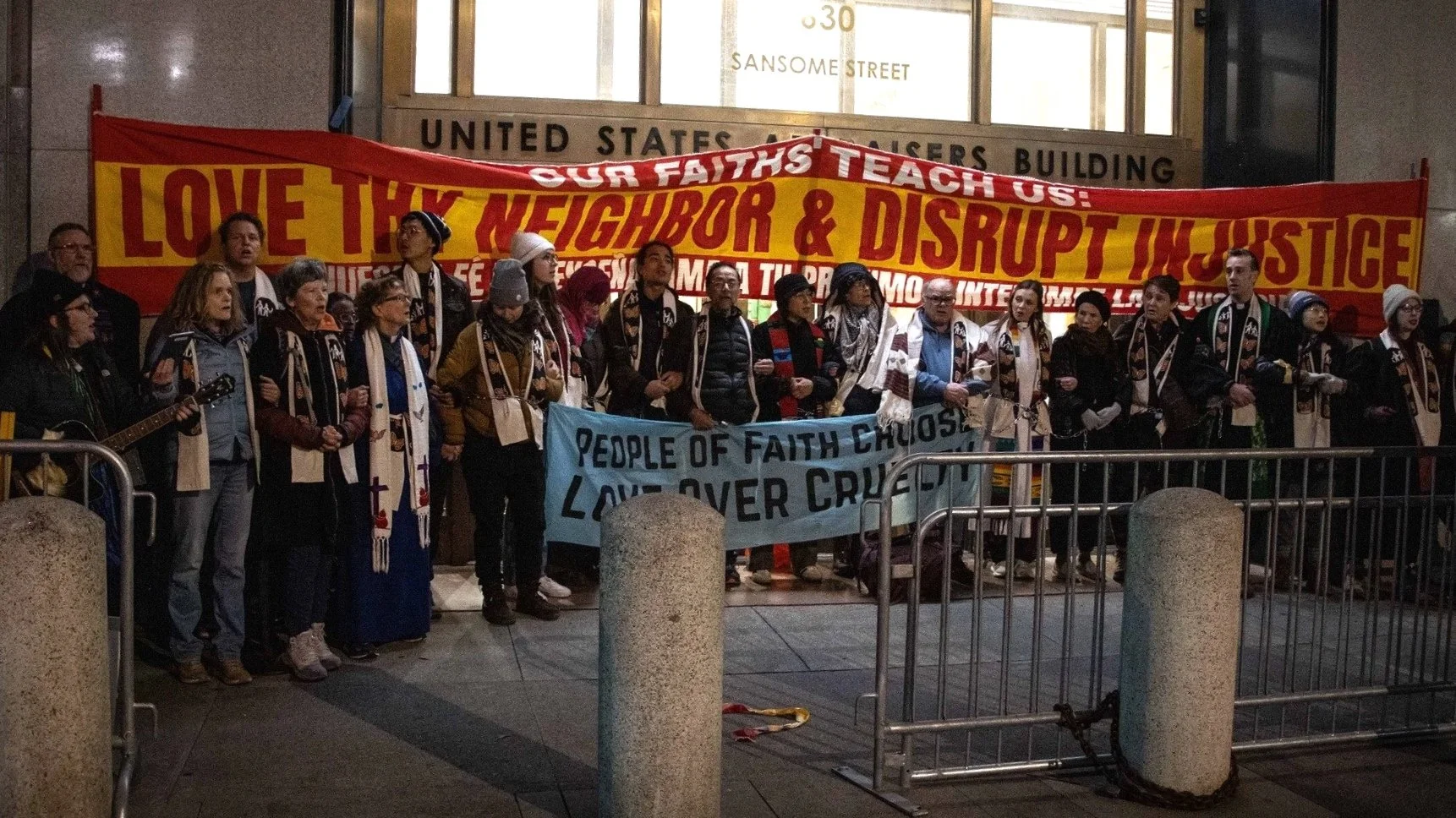
Group of faith leaders including Rev. Leah Martens with guitar (left) blocking the entrance of SF Federal Building. Photo credit: Peg Hunter
Last month, on a crisp mid-December Tuesday, in the dark, early hours of the morning, I joined a diverse group of faith leaders as we approached a federal building in the heart of San Francisco. We had come from a variety of places and backgrounds, but all of us were there for a common purpose. As the doors were secured, and some brave members of our group chained themselves to them, I started with the task for which I had come.
“We are not afraid. We are not afraid. We will sing for liberation ‘cause we know why we were made…”
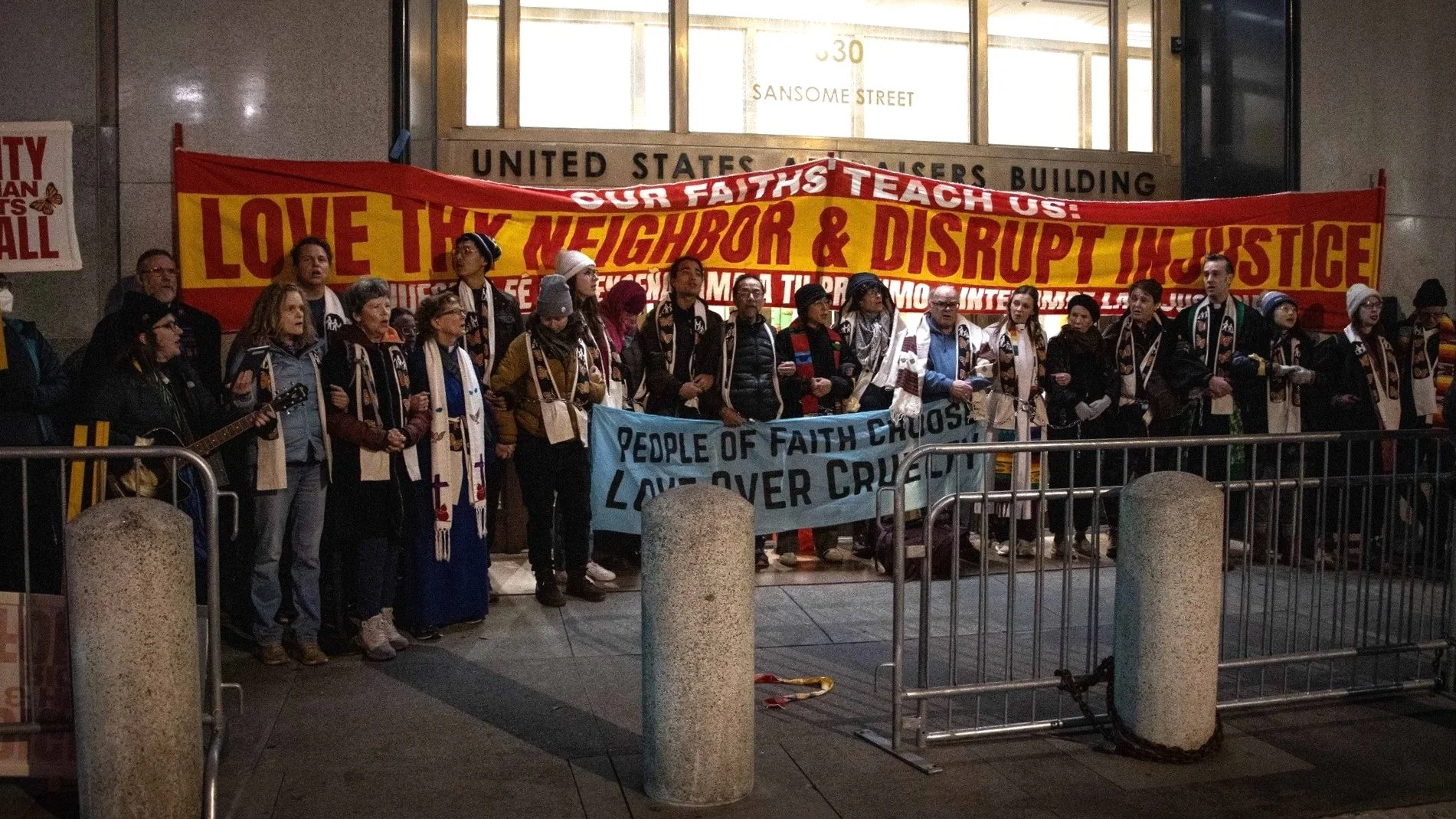
I was there with a microphone before my mouth and a guitar in my hands to lead song. Song would be the soundtrack to our action. While there are certainly places for popular chants in demonstrations to be sure, this was not an action set to shouts of “Hey hey…ho ho…” This was an action that would be carried out through the public witness of prayer, art, brave nonviolent direct action, and songs of solidarity, care and love. As we sang those first lines of “We are not afraid”, a banner above the heads of our group was unfurled. It read in English and Spanish “Our Faiths Teach Us Love Thy Neighbor and Disrupt Injustice”.
We were there to do just that. The building we were blocking is a space where we knew deep injustices are happening. Every day, people trying to legally comply with the challenging immigration system our government has put in place have found themselves vulnerable, as the administration weaponizes their court hearings, their mandated ICE check-ins, and their green card appointments to lure immigrants to a space where they can be kidnapped, processed and sent to cruel immigration centers hours away from their family members. For one day, this group of faith leaders was standing up to say, “Not today.” Today we want the building closed. Today we want check-ins and court hearings cancelled. Today we want our neighbors to be safe at home with their families. Because our faiths teach us to love our neighbors and disrupt injustice.
All of us who were gathered knew there were risks to this action. But we also knew that those who are called to that building every day are assuming risk in coming. Many of us, like myself, have spent months ministering to those people on the outside of the building, knowing that some of them wouldn’t come out. We’ve come sharing coffee, snacks, prayers, songs of solidarity, and helpful legal information, yet always knowing that our efforts on the sidewalk couldn’t prevent the danger that may await folks once they walk inside. But that December Tuesday, we were there to do more than witness the vulnerability of our neighbors. We were there to stand with them in a vulnerable space.
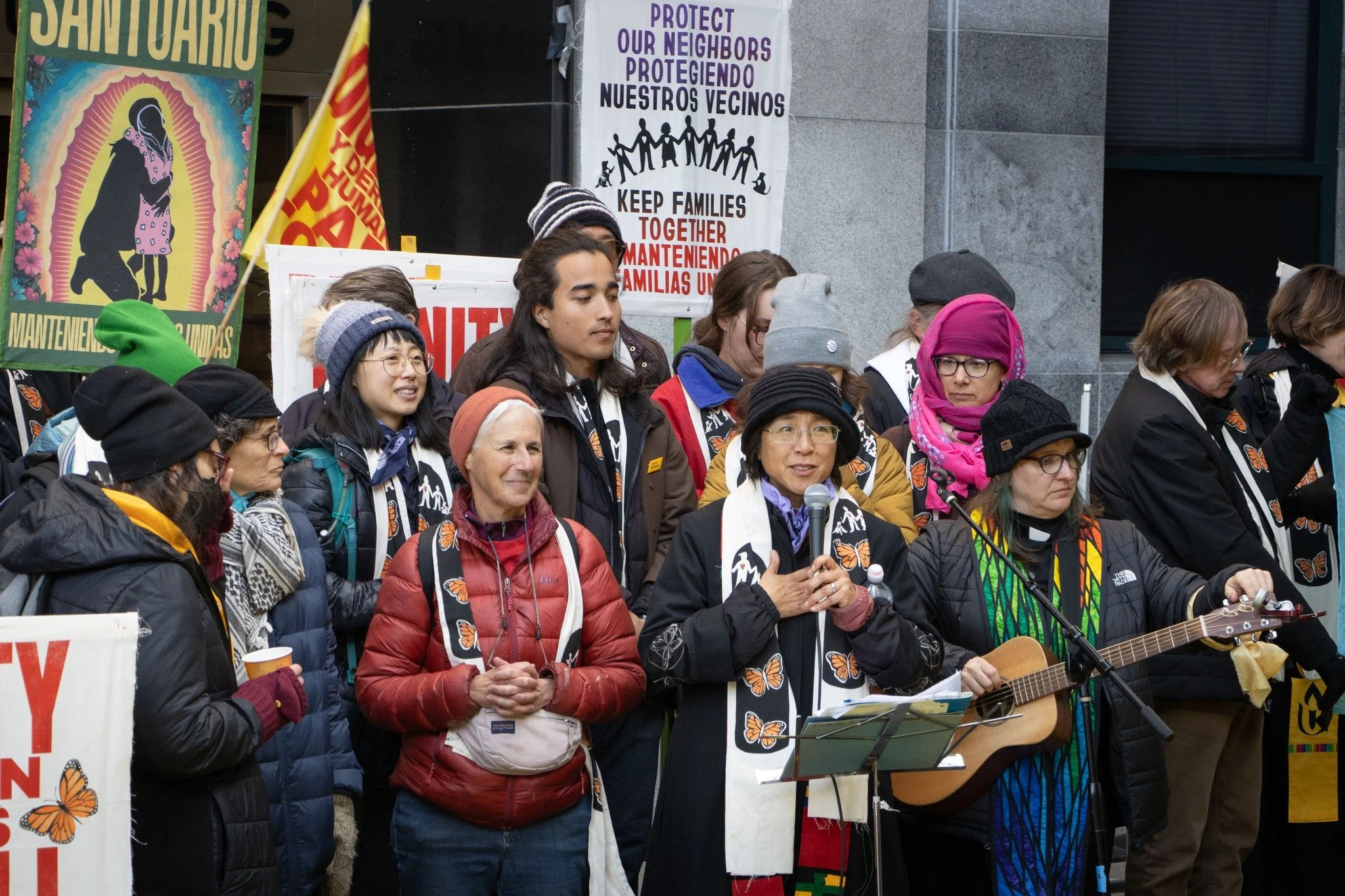
Rev. Deborah Lee and other faith leaders after being arrested and released. Photo credit: Peg Hunter
At one point, the Reverend Deborah Lee, one of the executive directors of the coalition Interfaith Movement for Human Integrity, spoke clearly the goal of the action. “Our demand today is that they close the building,” she named. “We want to guarantee that there will be no arrests today, and the only way we can guarantee it is to make sure that there are no appointments today.” She named clearly the truth: that our goal in gathering there was not to be arrested ourselves, but we were willing to risk arrest if that was what was required in order to keep others safe there that day. After several hours, singing in the face of multiple orders to disperse, I handed off my guitar before I was put in handcuffs for the first time. All in all, 44 of us were indeed arrested, cited and eventually released. But ultimately our goal was accomplished. The building was closed for the day. No appointments happened. All those in line for check-ins went home. No immigrants were kidnapped that day.
This action happened just over a week before Christmas. Christmas is a holiday in my tradition that, at it’s heart, I believe, testifies to the hope that the Divine, however we name them, loves us. God loves this created world. God cares for us. And because God loves, God cannot stay distant in the face of suffering. God’s love does not permit God to stand and watch injustice, violence, and loss take place unanswered. God must come close. God must choose solidarity with the suffering and the vulnerable. And so God does. The Divine becomes vulnerable themselves. God inhabits this world as one who is vulnerable - a poor migrant infant, born amidst the whiff of scandal, into an oppressed people under a violent occupying empire. This God does because God loves. This God does to empower the love of all of us who are made in God’s image. God chooses vulnerable solidarity so that we can follow God’s pattern; that we too can resist fear with the antidote of embodied love.
The morning of our action, after the doors were blocked and the banner unfurled, a public call went out on social media to others to come and join in support of the action. “Love calls us” was the title given to what was happening at the federal building that day. Love was the reason people were there. It wasn’t for notoriety. It wasn’t to shout four letter words at the authorities. The risks weren’t being taken lightly and they weren’t reactive responses of anger, as righteous as the anger might be. These actions were taken because people felt compelled by love to take them; to live out in real time the words those banners proclaimed, “Love thy neighbor and disrupt injustice”. Across traditions, together we were standing up for a call that transcends our particular faith expressions. Not all of us are called to risk arrest. But I believe all of us are called to resist fear, and show up in love.
Days before the action, I wrote a song that I felt honored to teach and sing together with my fellow faith leaders that morning, giving voice to why we were there.
God does not leave anyone alone, so we will not leave anyone alone.
We’re called to protect our neighbors, we’re here to protect our neighbors.
If you come for them, you’ll have to go through us.
If you come for them, you’ll have to go through us.
Singing this song alongside other deeply spiritual leaders of a variety of faith traditions - a number of whom had literally chained themselves to a building to protect others from being harmed there - did something deep in me. It fostered a profound sense of alignment of belief and action that reverberated throughout my body and my spirit. And even weeks later, that feeling of alignment reverberates in me still. It reverberated just days ago as I received the news, minutes after it broke, of Nicole Good’s murder while I was actually leading song at another rally in front of that same ICE building in San Francisco. It reverberated later that night as I strummed my guitar and taught my new song at a vigil in her memory in Oakland. And it reverberates in me now as I prepare to answer the call from our family of faith leaders in Minneapolis to join the multi-faith coalition from around the country traveling to Minnesota this week.
Once again, I am aware of stepping into vulnerability. As a Californian who spent over 20 years living in the midwest, I know there’s vulnerability just stepping outside in the dead of winter. That’s not even to speak of the unrelenting violence being unleashed by the federal government in Minnesota presently. And yet, Love continues to call us forward. I have learned that when I answer Her call, things shift for the better. So I’m packing up my song sheets and my best winter wear and heading back to the midwest. And I prayer that however and wherever Love calls you forward, you too would find what you need to be brave and join the song.
“We are not afraid. We are not afraid. We will sing for liberation ‘cause we know why we were made…”